The Subdivision and Housing Developers Association (SHDA) in the Philippines advocates for data-informed, people-centered housing strategies that align with the country’s evolving demographic and socio-economic realities. The association cited findings from a policy dialogue organized by the Philippine Institute for Development Studies (PIDS).
“To meet the real and evolving needs of Filipino households, housing programs must go beyond a one-size-fits-all approach,” said Mr. Ducay. “We propose a segmented policy framework that tailors interventions to the distinct realities of single-person households, elderly residents, and extended families, ensuring each demographic is supported with appropriate, accessible, and sustainable housing solutions.”
To address these shifts, Mr. Ducay presented a menu of policy options to housing based on four distinct household financing scenarios: those with no access to housing finance; those who have access but lack affordability; those who require subsidies; and those who can afford and access housing. This framework reinforces the need for differentiated and sustainable housing interventions that reflect Filipino households’ real capacities and contexts.
SHDA supports the development of targeted housing solutions grounded in actual demographic patterns. For single-person households and young professionals, this involves affordable rentals, compact units located near urban centers, and innovative financing mechanisms such as co-borrowing among peers or partners. For extended and multifamily households, SHDA advocates shared-living models and the strategic reuse of idle housing stock, including foreclosed government-owned properties and underutilized buildings, such as former POGO facilities.
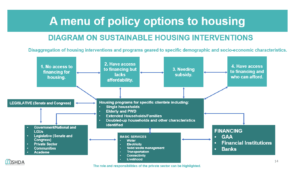
For elderly individuals and persons with disabilities, SHDA recommends the creation of retirement-friendly developments that comply with BP 344accessibility standards (An Act to Enhance Mobility of Disabled Persons by Requiring Certain Buildings, Institutions, Establishments and Public Utilities to Install Facilities and Other Devices) and support aging in place through proximity to medical services and community care. Urban migrant workers, meanwhile, would benefit from rental housing developments situated near major employment hubs, integrated with transportation networks, essential services, and livelihood support. In response to the rise of remote and digital-era workers, SHDA also promotes the development of digitally connected communities designed to support emerging work and lifestyle models.
In addition to proposing differentiated housing models, SHDA urges stronger collaboration between national government agencies, local government units, the private sector, and civil society. This multi-sectoral approach is essential to planning and implementing inclusive housing strategies that address both current realities and future needs.
“Housing development must not only keep pace with demographic change, it must lead the way,” Mr. Ducay stated. “We must move beyond building more homes to building the right homes for the right people at the right time.”