The town of Mulanay in Quezon province has undergone significant evolution since the 1996 film “Mulanay: Sa Pusod ng Paraiso,” which portrayed it as an underserved rural community. Today, Mulanay is a first-class municipality characterized by diversity and inclusion, creating opportunities for residents, including persons with disabilities. Notably, the local government, through the Municipal Social Welfare and Development (MSWD) office, has established a partnership with ATRIEV, PLDT, and Smart to provide training on entrepreneurship and digital innovations for residents with disabilities. This initiative is part of the PLDT Group’s Inclusion, Diversity, Equity, and Advocacy through Technology (IDEATe) program, which aims to uplift vulnerable sectors in the community.
“As a father to a child with autism, I understand the challenges that persons with disabilities face,” said Mulanay Mayor Aristotle Aguirre. “That is why we are working with like-minded organizations to provide them with digital skills and entrepreneurial opportunities, so they can start or grow their own businesses and thrive in today’s economy.”
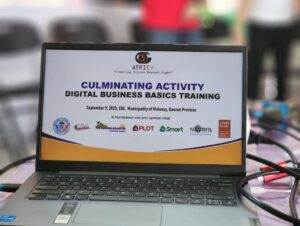
Conducted by ATRIEV and supported by the NORFIL Foundation, more than 20 persons with disabilities and their caregivers attended the Digital Business Basics Training (DBBT). The eight-day workshop was divided into two modules. The first focused on starting a business, covering essential topics such as branding, connecting with target markets, fund sourcing, and pricing and costing strategies.
Sergio Macarang, 55, saw his clients dwindle after he got into a vehicular accident that limited his mobility. He was a construction foreman before the accident. He turned to selling medical masks and wipes to supplement his income. And now, he wants to grow his business.
“You need careful planning,” Macarang said. “You have to learn proper costing, so you don’t end up selling your products at a loss.”
Pricing was also the most essential skill for 26-year-old Jerald Regencia, a reseller of beauty products born with physical impairments. “I was intimidated at first because I had forgotten my Math,” he recalled. “But I brushed up on my Math skills to ensure that I am earning from my business. You have to factor in all your expenses.”
The second module provided participants with hands-on experience using digital tools and social media platforms to expand their reach, including setting up Facebook and TikTok accounts and creating content for their pages.
“I was even able to design a logo for my business using a mobile app,” Macarang added. “Through Facebook and other online platforms, I can now reach more people and potential customers. My business is no longer limited to foot traffic on our street — it has grown beyond our community.”
“Selling online has really made things easier for me,” Regencia shared. “Before, I had to personally visit my suki to show them new items or ask if they wanted to order again — which wasn’t easy because of my condition. Now, I can just promote my products online and connect with them through messaging apps.”
Through inclusive initiatives like this, the stories of persons with disabilities in Mulanay are moving toward brighter chapters. Equipped with digital skills and business know-how, their journeys are only just beginning.
“At PLDT and Smart, we believe that technology is a powerful equalizer,” said Stephanie Orlino, AVP and Head of the Stakeholder Engagement Team. “Through programs like IDEATe, we are opening doors for persons with disabilities to participate fully in the digital economy, giving them the tools and opportunities to improve their lives and contribute meaningfully to society.”
IDEATe activities are aligned with PLDT and Smart’s commitment to help the country achieve UN Sustainable Development Goal 8 on decent work and economic growth, as well as UN Sustainable Development Goal 10 on reducing inequality by empowering and promoting the social, financial, and political inclusion of all, including persons with disabilities.